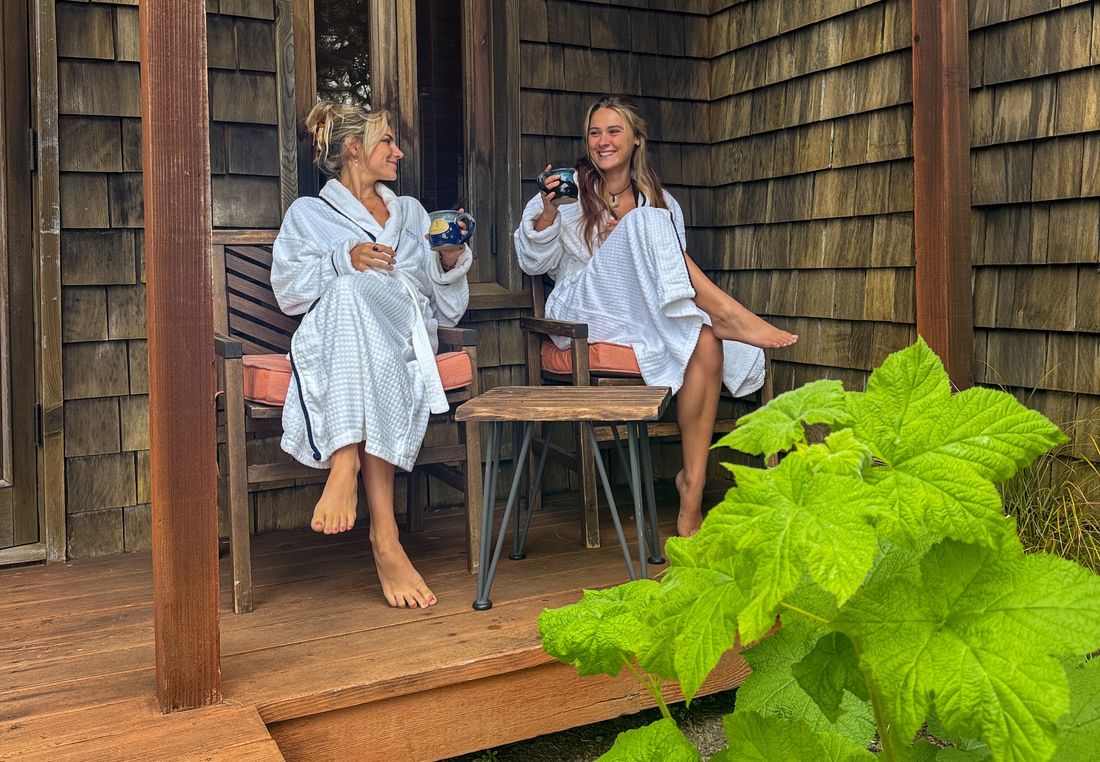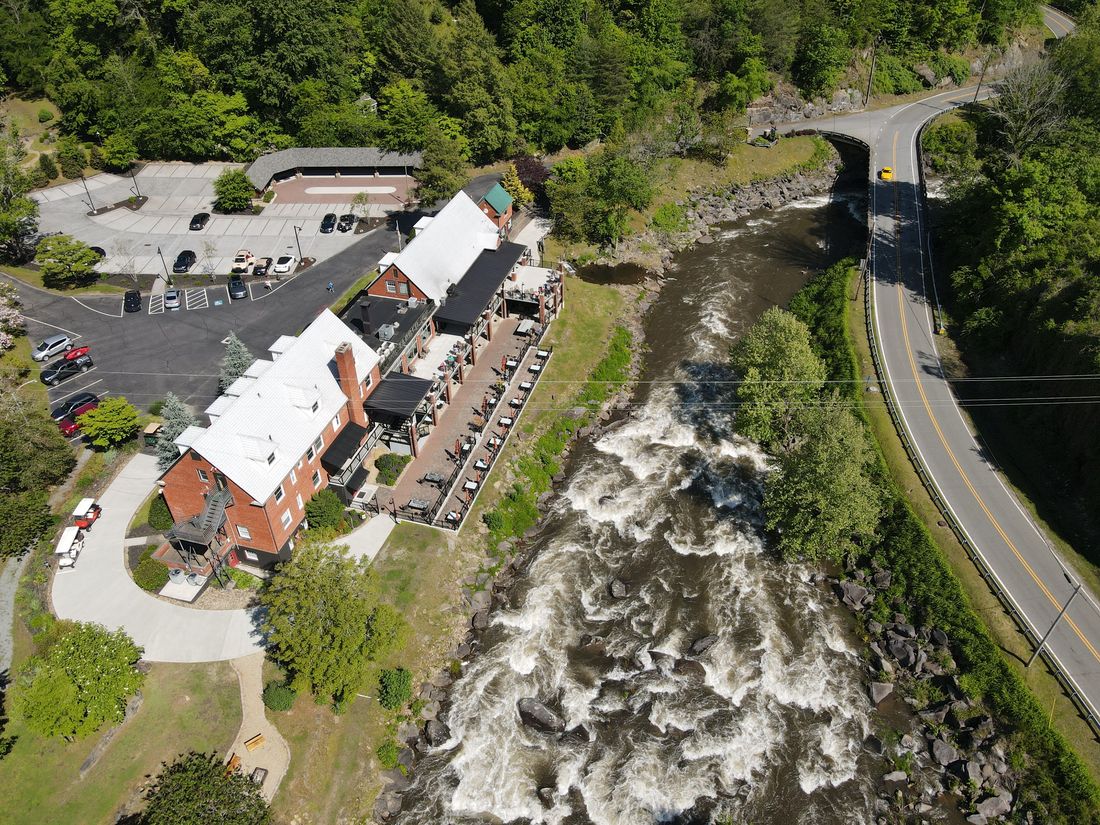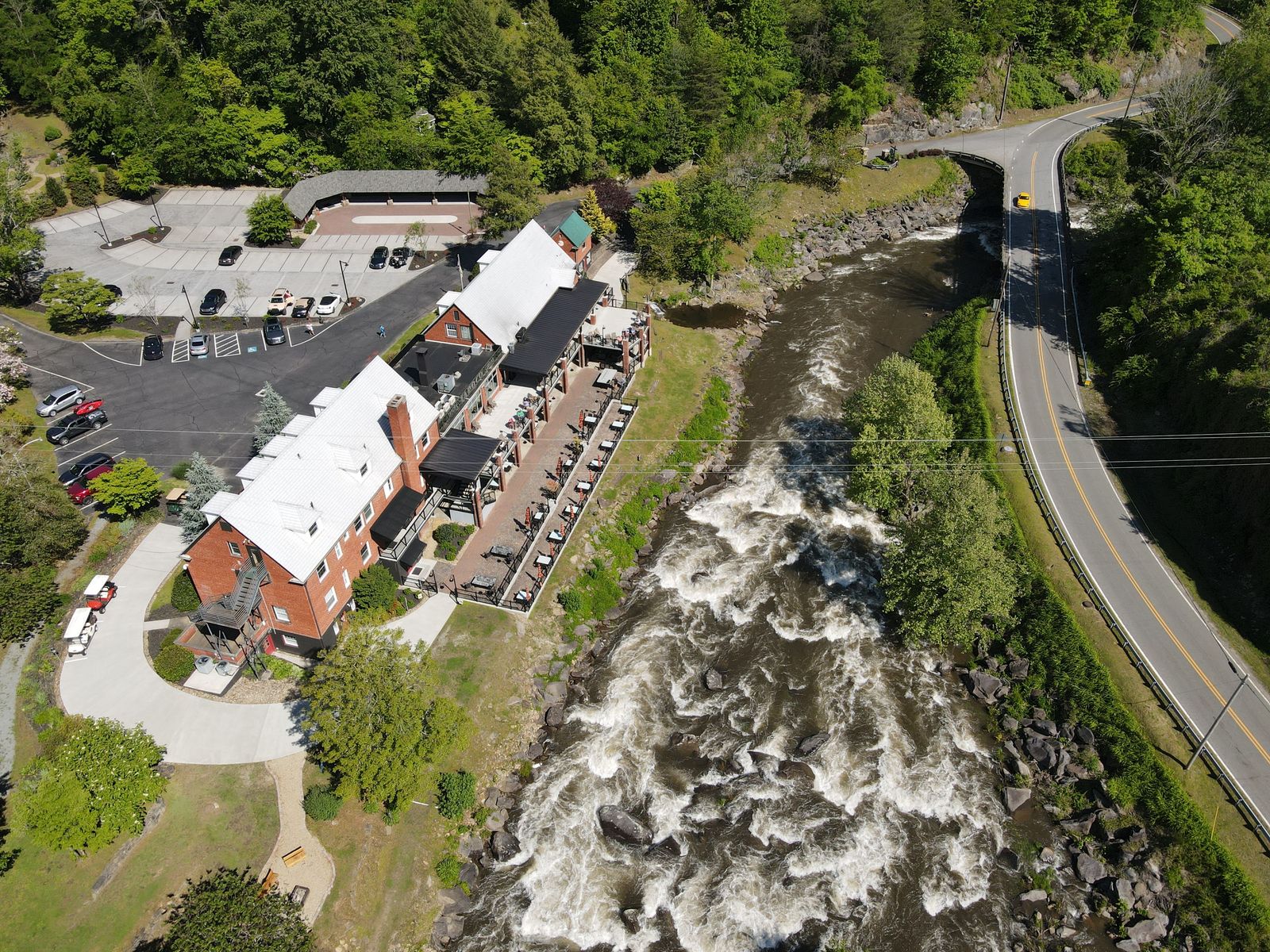
At Historic Tapoco Lodge, the forest isn’t the view. It’s the address. Our 1930 lodge sits on 120 acres deep in the Nantahala National Forest, on the banks of the Cheoah River, an hour and a world away from the nearest city — surrounded by some of the oldest, most biodiverse woodland in the eastern United States. Guests come for the river and the mountains. What many don’t realize is that simply being here, among the trees, is doing measurable good for their bodies and minds.
There’s a name for it — forest bathing — and a growing body of science behind it. Here’s what the research actually says, and why there are few better places to put it into practice than right here.
Where you are: inside the forest, not beside it
Most “forest” getaways put you near the woods. Tapoco puts you in them. The lodge is wrapped in the Nantahala National Forest and sits a short drive from Joyce Kilmer Memorial Forest — one of the largest remaining stands of old-growth forest in the East, where tulip poplars have stood for more than 400 years and measure 20 feet around. This is not a manicured park. It’s a living, ancient forest, with the Cheoah River running through it and the Great Smoky Mountains rising all around. As you’ll see, that distinction turns out to matter more than you’d think.
What is forest bathing?
Forest bathing is the English name for shinrin-yoku, a Japanese practice that dates to 1982. It doesn’t involve water, and it’s more than a hike — it simply means immersing yourself in the atmosphere of the forest with all your senses: the light through the leaves, the sound of the river, the smell of the trees. As Cleveland Clinic psychologist Dr. Susan Albers explains, the intent is to put you in touch with the present moment so deeply that the brain “stop[s] anticipating, recalling, ruminating and worrying” (Cleveland Clinic, 2023). If that sounds like mindfulness, it is — practiced outdoors, with the forest doing most of the work.
What the science actually says
Shinrin-yoku is only about four decades old as a field of study, so the research is still young, and honest researchers are careful not to overclaim. But what we do have is striking — and much of it points to the forest itself, not just “the outdoors.”
Your stress hormones drop
In a landmark study, Japanese researchers measured 280 people across 24 different forests. Compared with time in a city, forest environments produced lower cortisol (the body’s main stress hormone), lower blood pressure, lower pulse rate, and a clear shift toward the parasympathetic “rest and digest” nervous system — the opposite of the fight-or-flight state that stress keeps us locked in (Park et al., 2010). A later meta-analysis confirmed the cortisol effect, with short forest visits lowering it by roughly 12 to 18 percent (Antonelli et al., 2019).
The trees give your immune system a boost
Here’s the part unique to forests. Trees release airborne compounds called phytoncides — natural oils that protect them from insects and disease. When we breathe them in, they appear to benefit us, too. In one study, people who spent time in a forest showed increased activity of natural killer cells — immune cells that help fight infection and cancer — along with higher levels of anti-cancer proteins (Li et al., 2010). In effect, the forest is aromatherapy you can’t get from a candle.
A real forest beats a city park
If you’ve wondered whether a walk around the block counts, the research has an answer: location matters. A 2022 study found that walking in an actual forest had a greater effect on cardiovascular health than walking in a city park. Green space of any kind helps — but the deeper and wilder the forest, the greater the effect. Which is rather the point of a place like this.
And there’s a dose
How much do you need? A study of nearly 20,000 people found that spending at least 120 minutes a week in nature was consistently linked to better health and well-being (White et al., 2019). Two hours a week. At Tapoco, you’ll clear that before lunch on your first day.
The honest version: Forest-bathing research is young, and no doctor is going to prescribe the woods as a cure. But the findings are consistent and the downside is nil — as Cleveland Clinic puts it, a few hours in nature won’t hurt you, and there’s a good chance it helps.
Why Tapoco Lodge is built for forest wellness
-2.jpg)
Private trails lead straight from the lodge into the forest — no drive required.
You can practice forest bathing anywhere there are trees. But a few things make Tapoco unusually suited to it — most of them the very conditions the research points to.
• You’re immersed, not adjacent. Private hiking trails lead straight from the lodge into the Nantahala forest, and old-growth Joyce Kilmer is minutes away. “Two hours a week in nature” isn’t a goal here; it’s just Tuesday.
• The screens actually switch off. The research agrees that stepping away from devices is part of the benefit — and Tapoco makes it effortless. The historic lodge rooms have no televisions, and the valley’s remoteness means the signal fades whether you like it or not. Here, unplugging isn’t a discipline; it’s the default.
• Rest is built in. After the trail: an in-room massage, a soak in a hot tub on your cabin deck, and a seat by a riverbank fire pit as the forest goes dark.
• The river never stops. Fall asleep to the sound of the Cheoah — the kind of natural white noise the body reads as safety.
• You’re fed well and simply. Riverside dining at the Cheoah Dining Room and Tapoco Tavern means nourishing meals you don’t have to plan or cook.
One honest word
Forest bathing is restorative — but it’s a practice, not a prescription. As Cleveland Clinic’s Dr. Albers notes, the benefits come from doing it regularly: “It’s like taking a piano lesson. If you never play the piano after that, the lesson doesn’t make much difference” (Cleveland Clinic, 2023). And while time in the woods can ease stress, anxiety, and low mood, it isn’t a substitute for medical or mental-health care; if you’re struggling, please reach out to a professional. Think of a few days at Tapoco as the place you learn what the forest can do — and a reason to keep finding your way back to the trees once you’re home.
Come into the woods
The forest has been doing this for four hundred years. All you have to do is show up.
Plan your forest escape at Tapoco Lodge
Or explore our rooms and riverside cabins. Two hours a week in nature is the science. A few days inside the Nantahala forest is the invitation.
Frequently asked questions
What is forest bathing (shinrin-yoku)?
It’s the practice of slowly, mindfully immersing yourself in a forest with all your senses — sight, sound, and smell. It isn’t a workout or a guided hike so much as a way of paying attention. Research links it to lower stress hormones, lower blood pressure, and improved mood.
Is forest bathing actually backed by science?
The field is young and researchers are careful not to overclaim, but studies consistently find that forest environments lower cortisol and shift the body toward its “rest and digest” state, and that time among trees can boost immune activity. It’s best understood as a well-supported wellness practice, not a medical treatment.
Do you need a guide to do it?
No. Trained forest-therapy guides exist, but you can practice on your own — walk slowly, put your phone away, and pay attention to what you see, hear, and smell. At Tapoco, the trails start at the lodge door.
How much time in the forest do I need?
Even 15 minutes helps, but the research points to at least two hours a week in nature for meaningful benefits, with a few hours at a time being ideal. A weekend in the forest clears that easily.
Why is Tapoco Lodge a good place for forest bathing?
The lodge sits on 120 acres inside the Nantahala National Forest, on the Cheoah River, minutes from the old-growth Joyce Kilmer forest — with private trails, no TVs in the historic rooms, and a remote setting that makes disconnecting effortless. It’s forest immersion by default.
Can a forest trip help with stress and burnout?
Time in nature measurably lowers stress hormones and calms the nervous system, which is why a forest reset can genuinely help with stress and burnout. Persistent symptoms also warrant support from a doctor or therapist.
Leave the screens. Follow the river. The trees will do the rest.
Sources
A note on the science: the studies below are the basis for the claims in this article. Link each to its source when you publish.
Park, B. J., Tsunetsugu, Y., Kasetani, T., Kagawa, T., & Miyazaki, Y. (2010). The physiological effects of Shinrin-yoku (forest bathing): evidence from field experiments in 24 forests across Japan. Environmental Health and Preventive Medicine, 15(1), 18–26. (via NIH/PMC)
Cleveland Clinic (2023). Forest Bathing: What It Is and Its Potential Benefits. Featuring Susan Albers, PsyD.
Li, Q., et al. (2010). A day trip to a forest park increases human natural killer activity and the expression of anti-cancer proteins in male subjects. Journal of Biological Regulators & Homeostatic Agents, 24(2), 157–165.
Antonelli, M., Barbieri, G., & Donelli, D. (2019). Effects of forest bathing (shinrin-yoku) on levels of cortisol as a stress biomarker: a systematic review and meta-analysis. International Journal of Biometeorology, 63(8), 1117–1134.
White, M. P., Alcock, I., Grellier, J., et al. (2019). Spending at least 120 minutes a week in nature is associated with good health and wellbeing. Scientific Reports, 9, 7730.
Forest vs. urban-park walking and cardiovascular health (2022). Comparative study, via PubMed. (Confirm full citation before publishing.)
Kaplan, R., & Kaplan, S. (1989). Attention Restoration Theory; Ulrich, R. S., et al. (1991). Stress Reduction Theory — foundational frameworks for nature and stress recovery.
~ The Tapoco Lodge Team